


Background: Signal was a twice-monthly propaganda publication by the Nazis that appeared in numerous languages. This article appeared during the hard winter of 1941-1942. It presents the standard Nazi argument that Germany’s attack on the Soviet Union was defensive. If Germany had not struck first, the Soviet Union would have overun Europe.
The source: “Was wäre geschehen, wenn...?,” Signal, 1. January 1942, pp. 3-5.
What Would Have Happened If...
by Otto Phillip Häfner
No documents can provide an adequate picture of misery of this area — whether on this side of the border of 1939 or on the area cut off by the Moscow Peace. Members of the local American embassy staff as well as many representatives of the American press had the opportunity to examine conditions themselves in the areas occupied by Finnish troops during the current war. This is the only way to have a proper understanding. Neglected fields, ruined and destroyed buildings, desecrated churches and cemeteries, a population living in absolute misery and given over to murder and mass deportations show what a hopeless situation the Finnish people would have faced under Soviet domination, even if it had not shared the fate of of Estonia and the other conquered Baltic nations, namely partial or complete physical liquidation. It shows the fate Finland had to expect if it had not taken care of its own security. Therefore the men of Finland gladly give their lives in a defensive war rather than waiting for the execution of themselves and their family members. From the Finnish answer to an American note of 11 November 1941 |
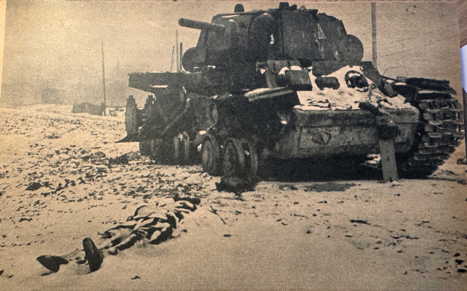
Imagine that the war against the Soviet Union had gone the other way. Bolshevist armies stood at the gates of or in Berlin, Hamburg and Helsinki were hopelessly surrounded, Upper Silesia and the Saxon industrial areas were occupied, large parts of southern Germany were conquered and the fighting was on Lake Constance rather than the Black Sea.This idea may seem absurd, but it is not as impossible as it seems on first glance. Only after the outbreak of the war did it become clear that Soviet armaments exceeded even the grimmest previous estimates. The enemy that the German Wehrmacht encountered on 22 June 1941 had superiority in materiel, above all in tanks. Would Germany have been able to counter a stronger enemy if that enemy had been able choose the time and benefit from the advantage of superiority in an attack? The intensity of the battle in the East is the clearest evidence thate the German leadership met the danger at the very last minute.
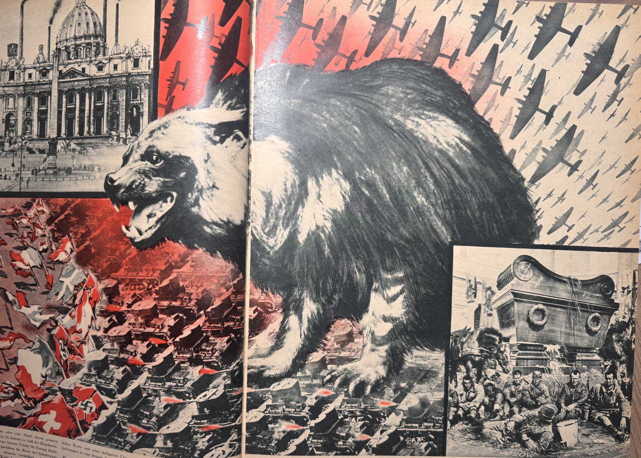
The Soviet army on Lake Constance or the border to Sweden: that is what a German defeat would have meant. That raises the question of whether Germany alone would have been a lost cause. Since the din of battle has migrated to regions whose geography even an educated European is learning under these circumstances, the meaning of this vast conflict is easily blurred by the growing distance. He who has not heard the thunder of cannons can lull himself into a false sense of security and tends to believe that he was never truly threatened. Had the flames come close enough that the smell of burning could be detected in the streets of Basel and Stockholm with a favorable wind, every other consideration would likely have receded behind the desire to save one's own hearth from Bolshevism. Had Germany proved too weak, who would have protected the Swiss, the Swedes, the Dutch, from Bolshevization? The Swiss and the Swedes themselves? Or the English? Or the Americans? In that case what is at stake would have been even clearer: not borders and more or less advantageous peace treaties, not national affiliations and differences of opinion of secondary or even primary importance, but rather the very personal fate of every single individual, the moral foundations of occidental culture, everything under the concepts of tradition and European history, and finally naked existence itself — or as the Finish government put it, the question of whether one wants to risk one’s own life or await one’s own execution and that of one’s family members. During the last two decades nearly every European country has had a communist party. Therefore, it does not take much political education to understand the goals of communism. Bolshevism wants world revolution. The individual state is only a stepping stone toward that goal, nothing more. Communist ideology is not directed against Germany because Germans live in Germany, but rather because Germany is the most important obstacle on this path; it is also directed against everyone and every nation. This has been stated countless times by Lenin and Stalin at every congress of the Communist Party. And it has likewise been made clear in pamphlets and speeches that the internal conditions for a general overthrow would have to emerge from as long a war as possible between the so-called imperialist great powers. Viewed from this perspective, Soviet policy over the last ten years enitrely follows this logic: alongside extreme armament, first maneuvering to provoke the confict in the first place and to secure important strategic positions, then the crossing over to the other side in order to restore the threatened balance; finally, extreme military readiness so that a blow could be struck at the given moment. It is certainly no coincidence that the Soviet Union is at war with all of its European neighbors. The Hungarians knew, just as well as the Finns and the Romanians, that it was their turn. And they also knew what would happen if the allied Europeans did not remain victorious. These peoples could smell the smoke, so to speak.
An Inadmissible Comparison
In 1939 Germany concluded a pact with the Soviet Union to break out of a life-threatening encirclement; since last summer, the Anglo-Saxons have been allied with the Bolsheviks. Is what is right for one not fair for the other? Looking back, the difference is nevertheless fundamental: through the Russian Pact, the Soviet Union was neutralized for a time and, in any case, kept away from the heart of Europe; at that time, the Reich could not prevent its brutal encroachments in all directions unless it wanted to walk into its own ruin with eyes wide open. Anglo-American aid, on the contrary, is intended to introduce the Bolsheviks into Europe. Through this aid, the Soviet Union is to be made capable of defeating Germany and its European allies — that is, to march to the Rhine. As unjustified as Anglo-Saxon optimism may be, it is no less true that the plan aims to see Voroshilov one day on the Swedish border, Zhukov in Trier, and Timoshenko, Budyonny, or whoever else on the Po and in Rome. But even if this were not the Anglo-American intention: who would contain the surge of the Bolshevist masses once the European front in the East had been flooded? And who would be strong enough to do so?
The Choice That Does Not Exist
At the so-called London Allied Conference, it was decided to revolutionize Europe. The British Foreign Secretary Eden considered revolutions the surest means to victory. The Soviet Ambassador Maisky described them as the very purpose of victory. Both want to spark revolts—that is, to provoke sabotage, strikes, assassinations, and uproar, and indeed not only in Berlin, but everywhere in Europe: in Athens, in Madrid, in Rome, in Paris, in Helsinki, in Bucharest, and in the countryside. Is it to be assumed that this chaos, as Mr. Eden perhaps thinks, would engender a gentle bourgeois era? Or is Mr. Maisky not rather right, who expects the advent of Bolshevism from a fratricidal war of all against all?
There is no more dangerous error than the view that that there are three possibilities: National Socialist Europe, Bolshevist Europe, and English Europe. English Europe is no real alternative, because (1) with the downfall of its Bolshevist ally, which is inevitable after the defeats suffered so far, every British chance of victory vanishes. Moreover, (2) any British victory presupposes complete European anarchy and general civil war, since the Anglo-Saxon war aim is directed precisely at the overthrow of existing orders. Out of anarchy, however, only Bolshevism or a variety of it could emerge. Thus it happens that Bolshevism remains a latent danger for Europe, even after the remnants of the Bolshevist armies have been destroyed. The choice, therefore, is not German Europe or English Europe, but Soviet Europe or an autonomous Europe that under German leadership rescues its essential values and its most sacred traditions for a better future.
A Hypothetical Question
In the Finnish reply note to the American State Department, the following passage is found regarding a conversation between Under Secretary of State Sumner Welles and the Finnish Envoy in Washington, Procopé: “Mr. Welles expressed that the Soviet Union would be the leading state in Eastern Europe after the end of the war. When Minister Procopé asked in the same context whether the point regarding disarmament contained in the declaration of Messrs. Roosevelt and Churchill also included the Soviet Union, Mr. Welles declared that this question was hypothetical.” Through this declaration, the picture of Europe as envisioned by Roosevelt and Churchill was rounded out in a very important point. Germany, provided it is not broken up into atoms, is to be disarmed together with its allies for all time. The Soviet Union, on the other hand, will remain armed and will have the leadership over the entire East—at least, therefore, over Finland, Romania, Bulgaria, the Dardanelles, Slovakia, Croatia, and over the entire territory that lies between the Elbe and the Dnieper. The Soviet Union is to be surrounded by a wreath of small states which, moreover, are unarmed, since most of them have fought on Germany’s side. Which of these Eastern states will be able to escape treaties of friendship and military bases that, following the example of the Baltic countries, lead to rapid Sovietization? What resistance would the Soviet Union encounter if it occurred to it to Bolshevize all of Europe step by step? As soon as Germany was eliminated as a power factor, there would be no resistance anymore. The German soldiers do not fight for Germany’s cause alone; rather, they protect with their bodies every European fatherland that deserves this name, and every cathedral that has not yet been transformed into a stable. Yes, even every present and future difference of opinion among Europeans. For only behind their lines is there freedom, while in front of them there is none.
Last edited 14 November 2026
Page copyright © 2026 by Randall Bytwerk. No unauthorized reproduction. My e-mail address is available on the FAQ page.
Go to the Signal page.
Go to the 1933-1945 Page.
Go to the German Propaganda Archive Home Page.