


Background: When the Nazis invaded the Soviet Union in June 1941, they encountered a propaganda windfall. Conditions in the Soviet Union were often deplorable by German standards. In January 1942, the Nazis published a 60-page booklet titled German Soldiers in the Soviet Union: Letters from the East. It consisted mostly of excerpts from letters from soldiers reporting on conditions they encountered. The letters, of course, were carefully selected, but soldiers had credibility and the booklet surely had an impact. Germans who read it, even if they had doubts about Adolf Hitler, were likely to conclude that National Socialism was surely preferable to Bolshevism. The book is divided into 9 chapters. I here translate several sections from each chapter. Wolfgang Diewerge, the author, produced at least five other Nazi anti-Semitic pamphlets.
The booklet, by the way, used the same cover drawing as the 1942 catalog for an exhibition on the Soviet Union, available elsewhere on the German Propaganda Archive.
The source: Wolfgang Diewerge, Deutsche Soldaten sehen die Sowjet-Union. Feldpostbriefe aus dem Osten (Berlin: Wilhelm Limpert-Verlag, 1941).
German Soldiers Observe the Soviet Union
Letters from the East
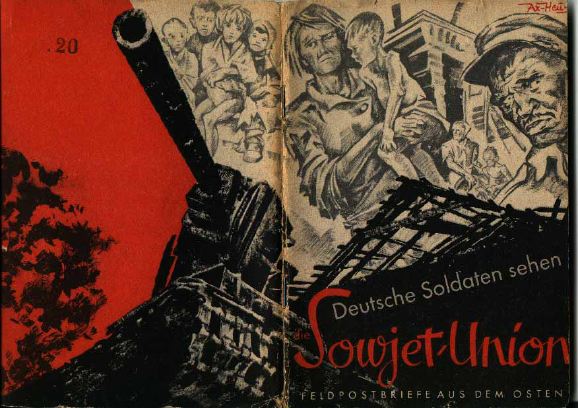
Front and Back Covers
The book begins with the following quotation from Goebbels:
“Lying enemy propaganda never tires of accusing us of giving the German people a false or incomplete picture of the battles in the East. They are best refuted by letters from our soldiers.”
Chapter 1
German Soldiers as Witnesses against Bolshevism
[Full Chapter]
The homeland hears about events at the front in an unbelievably short time. German radio often brings reports in the evening of deeds of arms that occurred only a few hours earlier, and the German newsreel includes pictures brought by air directly from the battlefields. The German people have almost direct contact with the accomplishments of their soldiers through the words, pictures, and reporting of modern news media. Past generations could not feel so closely bound to their family members.
Still, the best and most personal source of news in war is and remains the letter. That which the husband or son, the brother, or the bridegroom puts on paper during a brief rest is not only longed for and treasured news from a beloved and irreplaceable person, but also a testimony and a report from one heart to another, one that speaks the right language. During World War I, the letters from the soldiers in field gray recorded the experiences and the integrity of determined fighters who were willing to give their all. During this war, too, millions of German soldiers have reported their powerful experiences. Every family carefully preserves these letters. In party local groups, within National Socialist organizations and in factories, these letters from comrades are passed from hand to hand as eyewitness reports of upright German men.
This pamphlet is a random sample of such letters. They were sent to us by citizens of every class and region. Many of them included this note: “As I read this letter, I thought that others had to read it, too.”
Yes, that is true! There are millions of German citizens who do not have that direct contact with the front. They need to read these letters. They all deal with a theme that is particularly relevant today for the entire German people: What does the Soviet Union really look like?
Sometimes people think the Führer’s propagandists exaggerate, though actual events have proven that what they say is less than the full truth. One thinks of the role of the Jews in unleashing this war or the horrors Poland committed against ethnic Germans. Some citizens who complained then about exaggerated reports of persecution and suffering today complain about 60,000 graves, victims of Polish murderers!
But the most convincing proof of the difference between what was said and reality is clear from the revelations about Bolshevism. This unmasking is particularly important, because millions of German citizens put their faith in the lying words of Jewish-communists. They were told that within the borders of the Soviet Union there was “the workers’ paradise, the true home of the workers of the world.” When National Socialist newspapers and books spoke of the social betrayal in the Soviet Union, or of the horrible mass murders, the misery of children, the hopeless poverty of the entire population, some doubted these well-founded and carefully considered statements.
Now there are millions of reliable witnesses in the middle of this “worker’s paradise.” They cannot be doubted. They are not traveling along carefully prepared streets, nor can Intourist guide them through a carefully selected factory. They must march meter by meter through the country. They fight for each village and each city, they see face-to-face the people who were for nearly 25 years the objects of Bolshevist domination.
Now these German soldiers write to their dear ones at home. They write what they have experienced an hour before. The letters are not always literary masterpieces. But they are as genuine as the men who wrote them.
Some soldiers do not conceal the fact that they were not always National Socialists. There are even letter writers who faced legal penalties for their support for communism in the past. Nearly all of them remember the communist phrases and doctrines of the System Era [before 1933]. They did not march into the Soviet Union expecting to find everything bad, but rather they were eager to see how things really were in the land of Lenin and Stalin. They reported what they saw, often in hastily written letters.
These letters are lined up here like a company on the front. They are not on parade, but rather ready for battle. Some soldiers and some letters are large or small, broad or narrow, intelligent or less so, sparse or enthusiastic. We see in the newsreels the faces of marching soldiers who greet us, sometimes tired and exhausted, always however with a clear, confident look and in the firm conviction that they are in the service of a good cause. These letters are the same.
They are only a small part of the enormous material available. There will certainly be some citizens who say: “We have received better and more interesting letters. That is fine. We can agree. We have chosen only letters that were clearly written with no expectation of later publication, letters that give an idea of what has impressed our soldiers.
Those Germans who read these letters, and those who wrote them, ask the question: “What would have happened to our women, mothers, and children if Bolshevist tanks and murderers had overrun our homeland?”
Surely many more reports of the Führer’s great campaigns will reach the public. Even now the whole nation is waiting for the hour when the secrets can be revealed and the deeds of those made clear who today are unknown heroes.
None of those later reports will surpass the immediacy of these simple soldiers’ letters, which are being published even as the fighting army is in the midst of bloody battles on the wide plains of the East. Perhaps some of the letter writers will read this small book in the hospital. Perhaps one or two say their last words in these letters.
That is why these letters move us so deeply. They demonstrate that this decisive battle did not come from the lust for power or conquest, from political vanity or excessive fanaticism. That is what our enemies say. But these letters show that the culture of Germany and of Europe hang on this battle. It will decide whether subhuman Bolshevism destroys all that which is noble and holy to Germans, or whether the German soldier and his brave allies will build the foundation of a new era of peace and freedom.
The soldiers whose letters here reach the public believe, along with all their comrades, in the necessity of the struggle and in the certainty of victory. Who can be less confident than these men who not only stared the world enemy Bolshevism in the eye, but also defeated it wherever they encountered it!
These letters touch on every aspect of life. Everything that concerns soldiers has been set on paper. Naturally the purely personal and family matters have been edited out, as have military details that could be of use to the enemy. We were able to select only the most interesting sections of letters. In each case, the name of the sender and his military address is given, often also the address of the receiver. That should bring pleasure to the writer who sees his words in print. It should also make it impossible for doubters to question the genuineness of the letters.
Chapter 2
The Worker’s Paradise
[Excerpts]
The most frequent theme in the letters is a discussion of the “Soviet Paradise.” Communist agitators spread this idea for years to the masses of Europe. Moscow claimed it was “a hell for exploiters and a paradise for workers.” The words of German soldiers are a blow to the face of the Bolshevist world deceivers.
Worse than Hell
Lieutenant Otto Deissenroth, Military Post
Number 12 827D writes to local group leader Kemmel in Altenau
(Mainfranken)
In the East, 30.7.1941
Dear Comrade Karl !
I write this letter from the desolation of a Ukrainian forest village, 40 kilometers from Kiev, which we hope to capture in a few days. The fruitful land of the Ukraine is all around us, but 20 years of Bolshevist mismanagement have brought it to ruin. The poverty, misery, and filth we have seen and experienced in the past weeks is indescribable. You back home cannot imagine the terrible results of Bolshevism in this fruitful land. Everything that we formerly read in newspapers and books pales in the face of terrible reality. Our eyes look in vain for some sign of construction, for a trace of progress, for a bit of culture. We yearn for the sight of a clean house, an orderly street, a few tended gardens, a few trees! Wherever we look there is filth, decay, desolation, misery, death, and suffering! Everywhere we see the ghost of Bolshevism in the tortured look of farmers, the blank stares of captives, the hundreds of murdered people, the farm houses, desolate buildings, and ruined houses. I sometimes think it is all the work of the devil. The land was rich when it was inhabited by German, Ukrainian, Czech, and Polish farmers. Then Bolshevism came, and with it enormous misery. Everything that was prosperous or cultured was killed or burned. I spoke with dozens of people whose family members, fathers, husbands, brothers, and sons perished somewhere in Murmansk, Siberia or the icy north. Thousands died during the great famine, particularly in 1932-1933. Thousands more ended up in prisons and jails. The misery of those freed from Bolshevism is indescribable. Any free expression was prohibited, any movement banned. Everything in nature that was beautiful, good, and free was destroyed. Everything created by God was exterminated! They took the blessing from the land and the soul from the people. They reduced them to the level of animals, impotent, miserable enslaved animals with no hope of life who did not know if they would be alive tomorrow, who lived from hand to mouth, and were happy only when someone killed them. Hell can be no worse that this “Soviet paradise.” There is no hope of salvation. What Bolshevism has done to humanity is a sin against God, a crime one cannot begin to understand. Every German who formerly thought Bolshevism was a worthy idea and who threatened we National Socialists with death and bloodshed only because we didn’t believe in this nonsense should be ashamed! We were right! We are all shaken and moved as we face this misery, this suffering, this hopeless Bolshevist life. They stole everything from these people except the very air they breathed. The land they inherited from their fathers became a collective, the property of the state, and they became slaves worse than those of the darkest Middle Ages in Germany. They had a tiny plot of land of their own, and even that was heavily taxed. They had to report to the collective’s commissars each morning, work the whole day, even Sunday, with no free time. They belonged to the state. They were supposedly paid, but rarely saw the money. They got 33 kopeks a day, about a third of a mark. They owned no plow, no spade, no wagon, no yoke. Everything supposedly belonged to everyone, everything belonged to the state. The Jews and party bigwigs lived in prosperity, the farmers had only hunger, misery, work, and death. No one felt himself responsible for the soil, no one felt the love we Germans have for our homeland, for soil that is ours. The knowledge of blood and soil had died out. I spoke with 30-year-olds who did not understand the concept of property. They had been educated in Soviet schools. That explains why they had no sense of culture, no need for it. Their homes are empty, cold and desolate, much poorer than in Poland. No pictures, no flowers break the desolation. The art of cooking also disappeared, given the food shortages. The daily diet consists of milk and bread, along with a bit of honey and a few potatoes. When one see this dismal poverty, one is reminded that these Bolshevist animals wanted to bring culture to us industrious, clean and creative Germans. How God has blessed us! How justified is the Führer’s claim to European leadership! The poorest German village is a pearl in comparison to these ruined Russian villages. Sometimes as I face the thousands of murdered people that we found in the cities and villages, and in the numerous occasions where we found women and children wailing over the corpses of their family members, or when they asked us to free their men who had been hauled off just before we arrived, I see the Führer before me. He saved an enslaved and raped humanity, giving it once more divine freedom and the blessing of a worthy existence. The last and deepest reason for this war is to restore the natural and godly order. It is a battle against slavery, against Bolshevist insanity. I am proud, deeply proud, that I may fight against this Bolshevist monster, fighting once again the enemy I fought to destroy during the hard years of struggle in Germany. I am proud of the wounds I suffered during the election battles in Germany, and I am proud of my new wounds, and of the medal that I now wear. It is as if the people here are awakening from a deep sleep. They cannot yet believe in their new freedom; they do not know where to begin. They sit down and wait for orders. Now they have them: “Go back to work, harvest the fields, now you have your own home.” That is what all the posters say, and one sees the masses at work in the fields. Man and nature are free again, God has his place once more, his eternal order has been restored. We National Socialist soldiers of Adolf Hitler have restored the godly order, though some call us heathens. That is the way life is. And what did those who spoke about God do? Ask them!”
[The chapter has 23 more excerpts from letters]
Chapter 3
Houses and Roads
[Excerpts]
The housing question was a favorite theme of Bolshevist agitation in Europe. They made vehement attacks on workers’ housing. Regardless of economic conditions, they demanded a room for every German. So-called communist artists portrayed the misery and ill-health of overpopulated workers’ districts.
The Soviet Union had 25 years to realize this point in their program. They had the raw materials and workers, as their armaments program demonstrated. Nothing stood in the way of establishing “paradise” in their corner of the world.
But with the exception of the Jews and party bigwigs, the soldiers write that everyone in the Soviet Union lives “worse than the animals” do by us.
[There are seven excerpts from letters. Here are two of them.]
Unimaginable Misery
Staff Sergeant Kurt Hummel, Military Post Number L 31 605 Lg Pa. Paris, to his local group
Northern Russia, 12 August 1941
Bolshevist conditions are indescribable. I had never imagined that such misery was possible. People here know nothing about electric lights, radio, newspapers, and the like. One can’t call what they live in houses. There are only shanties with rotten straw roofs. Huge neglected fields lay around. We haven’t yet found even a small shop. This is what people call the Soviet paradise. I wish the few outsiders who still remain in Germany could be shipped here. There is misery wherever one looks. One has to see it to realize how beautiful Germany is.
The Main Roads are like Paths
Soldier Heinrich Stähr tells his workmates at the Hamburg Hochbahn A. G. about conditions frequently mentioned in other letters as well:
The roads. We in the infantry are probably the best judge of good and bad roads, since we have to march for kilometer after kilometer on them. Here, too, the Soviets haven’t lifted a finger. The main roads are no better than field paths. Believe me, my dear comrades, the soldiers have had many a justifiable curse after marching 40 or 50 kilometers on such a road. Besides, it is 30-35 degrees C. in the shade and huge clouds of dust make it almost impossible to breathe. Swamps, forests, and bad roads make military action unpleasant, but we keep moving forward.
Chapter 4
Rule by Bigwigs and Jews
[Excerpts]
The Soviet Union was in fact a paradise for one group: the Jews. Even at times when for foreign policy reasons Jews were less evident in the government or when they ruled through straw men, the Jews were always visible in the middle and lower levels of the administration. During the whole period of the red dictatorship, they were the beneficiaries. This was clearest in the small nations that the Soviet Union was using to prepare for its attack on the Greater German Reich after the outbreak of Churchill’s war, above all in the Baltic states.
Aside from their unlimited desire for money, their dirty behavior and their perverse thirst for revenge, our soldiers above all encountered Jews as the sadistic organizers of mass murders and atrocities. Many details have to be eliminated, since they cannot be printed in Germany. But this will be an idea of what was the routine day, and even more at night, in the dungeons of the Jewish GPU commissars.
[Here are two of the four letter excerpts]
The Jew was a Bloodsucker
Medical corporal Paul Lenz, Military Post Number 7 14 628 Posen, to the local group of the NSDAP, Arneburg:
Only a Jew can be a Bolshevist; for these bloodsuckers there is nothing better to be, for there is then nothing to stop them. Wherever one spits there is a Jew, whether in a city or a village. As far as I know (we asked the people, wanting to know the truth) not a single Jew every worked in the workers’ paradise. Even the littlest bloodsucker had a post with big privileges. He lived in the best buildings, if one can call them buildings. The real workers lived in small buildings, or better, in animal stalls, just like day laborers in old Russia. It makes no difference whether one is in a village or in a city like Minsk with over 300,000 inhabitants, the stalls are everywhere. Even before the war, most workers knew nothing but hunger, misery, and slavery. Some may be interested to know that there were theaters, operas, etc., even big buildings for them, but only those with money got in, and they were the bloodsuckers and their lackeys.
Only the Jew Lived Well
Soldier Reinold Mahnke, Military Post Number 02 179 to Supervisor Borrmann at the Otto Kloss Company in Hamburg:
Dünaberg, 8 Aug. 1941
Dear Hermann, You have to have seen what people called the Bolshevist Paradise! It is poor, Hermann, incredibly poor. Only Jews and functionaries lived well. The people didn’t earn enough to buy a pair of socks or anything like that. They earned 1 ruble a day, about 10 German pfennig, and that for a full day’s work. Only the Jews lived well. Each city is about 40% Jewish.
The Jews and Bolshevists hauled every Latvian who was still around out of his house before the Germans arrived. They stole the valuables, doused the houses with gasoline, and set them on fire. The Latvians who did not want to go with the Bolshevists had their hands and feet cut off, their tongue slit, and then were left behind. They nailed men and even children to the walls.
These are things we have seen.
If these criminals had reached our country, they would have torn us apart. That is clear. But the Latvians did take their revenge.
The comrades from the Kloss factory should come here and see what 25 years of communism have done. There is only poverty, misery, and more misery. Old sod huts, a cow and a pig, that is all they have. In Germany people talked about how good the workers here had it.
Chapter 5
Bolshevist Atrocities
[Excerpts]
Germans in general, and German soldiers in particular, do not take revenge on defenseless opponents, or even torture them. The opposite is the case. The danger is that German generosity will too quickly lead us to forget our victorious position, and presume our own decent attitudes and behavior on the part of the enemy, whether soldier or civilian.
That is why news of atrocities that our enemies commit against Germans or the civilians under their rule are often greeted with a certain skepticism. One doesn’t not believe others can do what one is oneself incapable of doing. We remember that reports of the bestial brutalities committed by Poles against ethnic Germans, especially in Bromberg, were thought to be exaggerated. Meanwhile, the German people have learned the truth.
But every bloody and sadistic butchery in human history is thrown into the shadows by that which German soldiers have already seen with their own eyes in the Soviet Union. As they themselves write, they will never forget it until they die!
We must not forget that these atrocities are incompetent work in the eyes of leading Bolshevists. Soldiers and commissars lacked the time during their retreats to use the bestial methods of GPU murder to torture their victims to the last. When those in the Kremlin read the atrocity reports in this booklet, they will be pleased that only a small part of their terrible crimes have become known to the civilized world.
Still, the dim rays of light that have reached Bolshevism’s torture chambers have revealed such frightening pictures that we are deeply shaken as we read these reports.
[Here are 4 of 9 accounts]
Children Slaughtered
Soldier Fred Fallnbigl to his Parents in Salzburg, 17.7.41
I wrote in my last two letters about Russian atrocities, and could fill volumes more.
But a bit more from the Soviet Paradise. I’ll especially tell you about things that happened in Lemberg-Tarnopol and Tromborla. Tromborla is due south of Tarnopol. I saw the prisons in Lemberg, and saw things that struck me deeply. There were men with their ears and noses cut off, etc. They had nailed children alive by their hands and feet to the wall, butchering them. The blood was ankle deep. It didn’t make any difference if they were alive or dead. They doused the piles of bodies with gasoline and set them on fire. The stench was terrible. I saw similar things in Tarnopol and Tromborla. In T. seven Ukrainians were hauled out of their beds after the Germans had arrived. The next morning their bodies were found in the woods, beaten until they were unrecognizable. I have seen all of this myself, they are not matters I heard about. Feel free to tell them to others, particularly those who may still think well of the Soviet Union.
I always think how fortunate we are that this scourge of humanity never made it to our country. I don’t think that even years of preparation would make Germans capable of such atrocities.
Corpses Defiled
Sergeant Paul Rubelt, Military Post Number 34 539 F, to
Miss Grete Egger, Lebring 71, Steiermark:
6.7.1941
I was in Lemberg yesterday and saw a bloodbath. It was terrible. Many had their skin stripped off, men were castrated, their eyes poked out, arms or legs chopped off. Some were nailed to the wall, 30-40 were sealed into a small room and suffocated. About 650 people in this area must have died in such ways. The stench can be endured only if one smokes a cigarette and keeps a handkerchief over one’s nose. The Jews did most of it. Now they have to dig the graves. The culprits will be shot. Many already died because of the stench. In this city they even opened graves and defiled the corpses. It is terrible. One can hardly believe that such people exist.
Orphans Nailed to the Wall and Slaughtered
NCO K. Suffner, Military Post Number 08 070 to his work mates
There was a gray cloud over Lemberg as we arrived. The stench was scarcely tolerable. The Russians had been thrown out of the city after a hard battle. Two hours later I found the source of the stench. The Bolshevists and Jews bestially murdered 12,000 Germans and Ukrainians. I saw pregnant women hanging by their feet in the GPU’s prison. They had slit the noses, ears, eyes, fingers, hands and arms and legs of other women. Some even had their hearts cut out. 300 orphans between the ages of 2 and 17 had been nailed to the wall and butchered. After they were done with the torture, they threw the people, most of whom were still alive, into a 3 meter deep pile in the basement, doused them with gasoline, and lit them on fire. It was terrible! We could not believe that shave suffered if Bolshevism had reached us. The complainers and know-it-alls that we still have in the Reich should see this. Then they would know what pure Bolshevism looks like. They would fall to their knees and thank the Führer for saving Germany from such things. I and many other German soldiers have seen this. We all thank the Führer that he let us see the Bolshevist “paradise.” We swear to extirpate this plague root and branch.
Since I have some time today, I thought it my duty to write this so that my workmates at home can read it. We soldiers at the front have seen this with our own eyes. We will be able to tell a lot more later.
We are fighting until final victory.
Terrible Mutilations
Lieutenant Lorenz Wächter to a Political Leader in Neunkirchen:
20.8.1941
...I really can’t describe what we saw in Lemberg. It is much, much worse that the German newspapers were able to describe. One has to have seen it. Even the stench of corpses, noticeable a long way outside the prison walls, was enough to make one ill. And the scene itself. Hundreds of murdered men, women, and children, hideously mutilated. Men had their eyes poked out, a pastor with his belly slit open and the body of a slaughtered baby stuffed in. I could tell you worse stories, but even these upset me, and I’m used to such things by now.
What Soldiers Want to Do with Grumblers
[Excerpts]
In the midst of all these experiences, observations and facts, nearly every soldier’s letter expresses the wish that the complainers and know-it-alls should see what they have seen! Everyone who has not yet understood the greatness of our age and the significance of this greatest of all battles should see it for himself for a week. Countless millions of our people do their duty and sacrifice in good spirits. They accept the inconveniences of the war cheerfully. But even the most willing occasionally tire of the necessary burdens of everyday life during war. These soldiers’ letters are good medicine in such moments. The facts German soldiers report home prove that there is no comparison between the war-related inconveniences we endure and the terrible conditions of perpetual misery that prevail even during “peace” in the Soviet Union. All the soldiers at the front wish that every German who even for a moment loses his energy and enthusiasm would have the chance to gain a personal impression of a country that despite the greatest natural resources and despite 25 years of uninterrupted rule by a government has the worst conditions in the world, conditions that can only be compared with the very worst English colonies. Looking into this abyss will banish all discontent.
[Here are 2 of 5 excerpts]
Every Critic of Our Efforts Should be Sent Here
Soldier Walter Sperath writes to the [NSDAP] county office Hamburg 6
Everything I have seen of the so-called workers’ paradise is everything but lovely. One should send every citizen who even slightly criticizes our efforts here. He would thank the Führer and the movement that these conditions are not found in our fatherland. Animals by us live in better conditions than the people here. Our successes so far have been great, and we will not stop until we have rooted out this evil root and branch, which will be a blessing for European culture and humanity.
The People’s Eyes are Being Opened
NCO Alfred Rothe, Military Post Number 27 643 to his Wife in Kostermannsfeld, Burgstr. 5:
24.7.1941
....even without the war, the people here were impoverished and exhausted. Only the bigwigs lived well in palaces. Now the people’s eyes are being opened. Anyone in Germany who still does not believe in communism’s terrible crimes should see for himself, and listen to the people. Happy Germany, as I always say.
Chapter 7
Former Communists Talk
[Excerpts]
Berlin was once a communist fortress, and there were also supposedly impregnable Red bastions in Hamburg, Saxony, the Ruhr, and Munich. There were some in the ranks of German communism who honestly believed in the blessings of Bolshevism. They were ready to serve as Moscow’s Foreign Legion and deny their German fatherland to build a life of dignity and beauty for the working class of the whole world.
Adolf Hitler’s powerful idea has long driven criminal communist thinking from the minds of every normal person in Germany. Among the millions of German soldiers who are now fighting as loyal followers of the Führer in Russia, there are certainly some who can remember some of the promises made by the Bolshevist traitors to the working class.
These citizens are the ones most shocked by what they see in the Soviet Union. Many a letter writer to his wife, his local group leader, or his S.A. leader mentions that he was formerly a communist. I mention one who served 2 1/2 years in prison, but now volunteered for the army even though he has seven children. He wants to atone for his sins. Now he writes back home as one who is fully converted.
We have omitted the names of some writers, since we were not sure whether a brave soldier doing his duty would want thousands of strangers to read that he was once a communist. We have the originals. Anyone who doubts the genuineness of these letters can receive the names and address of the writers, if he has good reason.
The Führer spoke from the hearts of these soldiers when he said of the Soviet Union on 3 October 1941:
“It is a country that our soldiers are coming to know after 25 years of Bolshevism. This I know: Anyone who went there with even the slightest sympathy for communism, even in the most idealistic sense, is cured. You can be sure of that.”
[3 of 9 Excerpts]
The Soviet Union is Absolutely Miserable
Flyer W. M., Res.-Lazarett Salzlwedel to his Cell Leader Schroeder
I have seen the “wonderful workers’ paradise” in the Soviet Union with all its terrible misery, and wish that those who thought differently could spend a few weeks here to see and experience what we have. The misery and horror of Bolshevism is terrible.
I hope that volunteering for our proud army may atone for my earlier sins, and that when I am back home, you, dear party member, will accept me as an honest person. In that hope, I send you my warmest greetings.
Heil Hitler!
signed W. M.
Earlier Fans of the Soviet Union are Quickly Cured
Corporal Otto Kien, Military Post Number 18, 756, to the Factory Leadership t the Conrad Scholtz Factory. Barmbeck
Russia, 8 August 1941
Anyone who earlier had different opinions of the Soviet Union is quickly cured of them here. The poverty is terrible. Not even the farmers have anything to eat. They beg from us. There are lice and filth everywhere. One has to be careful one doesn’t get them from the inhabitants.
These people don’t know anything else. They sit in their huts and remove lice from each other. They don’t mind if anyone watches. I’ve had my fill of this workers’ paradise. We’ll be glad to be out of here. In the past we saw pictures of malnourished children. They were not exaggerated. One can’t believe it if one hasn’t been here.
Worse than we Imagined
Corporal J. F., Military Post Number 26,280
to his Local Group
In the Field, 3.8.41
What we have seen of the so-called Soviet paradise is worse than we ever imagined. Anyone back home who still has any doubts should come here. All his doubts will disappear. Everywhere we go, the people are happy to be freed from Bolshevism, and looks to the future with confidence. We soldiers can say to those back home that he saved Germany and all of Europe from the Red Army. The battle is hard, but we know what we are fighting for, and confident of the Führer, we will win. In the hopes of a victorious return,
Heil Hitler
Corporal J. F.
Chapter 8
Germany: The Most Beautiful Homeland
[Excerpts]
No one has greater right to evaluate a country than the soldier who is ready to give his life for it. We know that German soldiers would fight and die for Germany, even if it were the poorest and most wretched land on earth.
In the Communist-Bolshevist “paradise,” however, the German soldier learned what Germany really means. “An employed man in Germany lives better than a lord in comparison to a Bolshevist worker,” one letter said, and we know that many Communists who fled to the Soviet Union would prefer to spend a long time in a German prison than live in Bolshevist freedom.
The letters are all a proud and confident affirmation of the Greater German Fatherland.
Germany the Most Beautiful Country in the Whole Wide World!
Corporal Karl Prox to County Propaganda Leader Friedrich, Groß-Strehlitz
In the East, 12.8.1941
We have hard weeks behind us, and are proud of our success against the Soviet foe. We now have time to recover from our exertions.
I am proud to be a German, and to be a member of our wonderful army. Greet everyone back home. I am a long way away. Tell them that Germany is the most beautiful, cultivated country in the whole world. Everyone should be happy to be a German and serve a Führer like Adolf Hitler.
[There are two other excerpts]
Chapter 9
Thanks to the Führer
[Excerpts]Some Germans on 22 June 1941 were not aware of the enormous danger threatening the Reich. Soldiers facing the enemy were the first to realize it. They are the best judges of the terrible misfortune that the Führer saved Germany and Europe from. Nearly every letter expresses deep thanks to the Führer.
The Führer Saw the Danger in Time
Soldier P. Woock, Military Post Number 33, 817, to his comrades at home:
Whatever it may cost, it is good that the Führer saw the danger in time. The battle had to come. Germany, what would have happened to you if this bestial stupid horde had poured into our homeland? We have all sworn allegiance to Adolf Hitler, and we must fulfill it for our own good, wherever we may be.
[There are two other excerpts]
[The pamphlet ends with the following summary]
These letters close with affirmations of loyalty to the Führer, and attacks on the murderous Jewish-Bolshevist swindle. We could give only a small selection of the thinking of German soldiers in this pamphlet, but these eyewitness accounts are so persuasive and frightening in their truthfulness that no one can ignore them.
Mr. Churchill, these are your Bolshevist allies for which you ask English churches to pray, and for whom English workers should forge new weapons! This is the culture of those you are protecting, Mr. Roosevelt. You want to save the world from “Nazi barbarians” with their help. With their help you are supposedly fighting for freedom and justice for smaller countries. And that, Mr. Stalin, is the judgment of millions of men on your Bolshevist policies, men whom you hoped to recruit as cannon fodder for the Bolshevist world revolution.
Things in the Soviet Union are far worse and terrifying than National Socialism ever claimed. The Soviet Jews hermetically sealed off their terrorized nation from the rest of the world. Even experts and enemies of Bolshevist doctrine could not form a true picture of the real events in the area ruled by Bolshevism. Even the fantasies of the most fanatic opponents of Bolshevism could not reach the true hopeless of the situation, revealed here in letters from German citizens at the front.
German soldiers saw the Soviet Union! They will never forget what they have seen. Never again will anyone in Europe dare to apologize, much less defend, Bolshevism and the results of its rule.
There are few families in Germany today that do not have a relative, and therefore an eyewitness of Bolshevism. These letters already circulate within families and factories, villages, and party local groups. Now they reach millions who are working for victory, giving them a broader picture of the experiences and impressions of their brothers and sons.
No one will put this pamphlet down without being deeply moved. His thoughts will then turn to the Führer, the man who in the midst of Germany’s deepest disgrace was the first to recognize and oppose the communist enemy. The few units of the SA and the SS that opposed the Bolshevist-Jewish enemy when Moscow’s terror still prevailed in the streets of our great cities, when Red revolution threatened whole states and provinces of the Reich, and Moscow’s Foreign Legion murdered German men on German soil, now have the whole German people with them. The enormous columns of German regiments and divisions are striking Bolshevism deep in Russia. At the right time and with careful forethought, the Führer, side by side with all the awakened European nations, gave the command to save the West. The decision was difficult, the scale of the struggle vast, and the results tremendous.
Everyone today can see that the order given on 22 June 1941 was the greatest decision in Europe’s life. The Bolshevist armies that today are being destroyed by the blows of the German army, blows from which they will never recover, were ready to attack Europe. Despite the treaties, the Bolshevist leaders were ready to attack when the hour was right. The presumed state of workers and soldiers had secret agreements with the plutocracies and capitalism. They were preparing the way for World Jewry to take over Central Europe.
If Stalin’s tanks and planes had crossed our borders, it would have been the end of everything noble and beautiful in the world. Europe would have been filled with enslaved masses like the prisoners our soldiers find today in the East. A whole part of the world would have fallen into filth and misery if Adolf Hitler had not at the last moment intervened to forever eliminate the criminal danger.
We may not forget it. Moscow’s criminals are praised as heroes and defenders of culture every day by the English and American press. People in London and New York pray for these animals in human form, and thousands of Jewish editors, speakers, and radio announcers are at work recruiting American youth to shed their blood for these subhumans.
This lying and decaying world of plutocracy along with its Bolshevist allies may not and will not win. No sacrifice is too great in comparison to what is at risk, and what victory will bring us in the future.
The letters from our soldiers during these decisive months will always be a testimony to our just cause. They are unique historical documents. Their significance is expressed by these words Propaganda Minister Dr. Goebbels, which we remind readers of in conclusion:
“One has to realize what would have happened if the Führer had not seen the danger of Bolshevism, and what is at risk. Our soldiers are witnesses of Moscow’s plans. They have seen with their own eyes Bolshevism’s plans to destroy Germany and Europe. They have had direct experience with the Soviet System and have been able to form a true picture of conditions in the paradise of workers and farmers. One must realize the significance of these facts for the future. Just as there was no debate in Germany about the Jewish Question after the Polish campaign, now there will be no debate about Bolshevism. This fiery struggle is more than a campaign or a war. It is an historic battle of fate in the broadest sense of the term.”
Last edited 13 July 2026
Page copyright © 1999 by Randall Bytwerk. No unauthorized reproduction. My e-mail address is available on the FAQ page.
Go to the 1933-1945 Page.
Go to the German Propaganda Archive Home Page.