


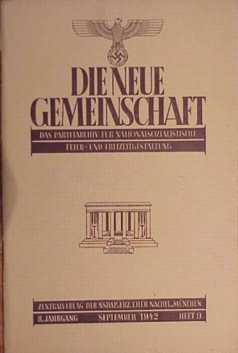
Background: 9 November was the holiest day on the Nazi calendar. The anniversary of the 1923 Beer Hall Putsch, it was celebrated in grand style to the end of Hitler’s Reich. There were major ceremonies in Munich, but also each party group was expected to hold its own ceremonies. The party provided material to help organize ceremonies on this and other occasions in a periodical called Die neue Gemeinschaft. Das Parteiarchiv für nationalsozialistische Feier- und Freizeitgestaltung. The following material was prepared for the 1942 events. See also a collection of Nazi artwork on the theme. The illustration is the cover of the issue.
The source: “Zum 9. November 1942. Gedenktag für die Gefallenen der Bewegung,” Die neue Gemeinschaft, 8 (September 1942), pp. 492-502.
9 November 1942
Memorial for the Movement’s Dead
 9 November brings
together the entire national community to remember the dead of the movement,
but also those who fell during the First World War and the current war.
The dead of 9 November 1923 sacrificed their lives for the seizure of
power and the re-strengthening of the Reich. Thus, the sixteen who died before
the Feldherrnhalle and all the blood sacrifices of the movement are firmly
bound to the fallen heroes of this war. We remember also our ancestors,
who came before us and who gave us life.
9 November brings
together the entire national community to remember the dead of the movement,
but also those who fell during the First World War and the current war.
The dead of 9 November 1923 sacrificed their lives for the seizure of
power and the re-strengthening of the Reich. Thus, the sixteen who died before
the Feldherrnhalle and all the blood sacrifices of the movement are firmly
bound to the fallen heroes of this war. We remember also our ancestors,
who came before us and who gave us life.
We decorate their graves to honor them.
“The Eternal Watch” in Munich is a symbol to us of this memory and also a symbol of eternal life.
We hold ceremonies appropriate to the dignity and significance of the occasion. We stand not in despairing sadness, but rather proud in the certainty that the spirit and the legacy of our dead live on and will continue to live in the eternal German Reich. The party includes in the ceremonies all organizations and groups, the military, and all citizens.
Since the ceremony of 9 November includes commemorating those who fell in this war, family members of the dead should be invited.
At the center of the ceremony for 9 November are the sixteen who died at the Feldherrnhalle, the dead of the World War, the blood victims of the movement, those who fell in the present war, and all of our ancestors, who through us and our children have given the German people eternal life. It should be the custom on 9 November to decorate not only the graves of heroes, but rather all the graves in the area.
The material here provides material, suggestions, advice, and examples for holding ceremonies appropriate for the varying resources of the Gaue, the counties, and local groups. For more examples, see past issues of Die neue Gemeinschaft.
The Hall
The hall available for the ceremony, its layout, and decoration, are important to the character of the ceremony, and conversely a certain ceremony requires the appropriate hall. The hall for the 9 November ceremony must be as simple and dignified as possible. Besides the flags and symbols of the movement, the Iron Cross of 1939 may also be used. “Coffin trappings” and “living pictures” have no place in our ceremonies. Avoid too many symbols.
The Elements of the Ceremony
This issue provides a large selection of music, ranging from simple to challenging.
The spoken texts must be recited plainly and simply.
Since the 9 November ceremonies are under the auspices of the party, all the organizations and affiliated groups should be involved. The male and female youth involved in the Reich Labor Front as well as the NS Culture Organization should also be involved.
Simple — but not primitive
The March 1942 issue of Die neue Gemeinschaft (p. 133) discussed how to hold ceremonies that are simple but not primitive.
The fundamentals need not be repeated, though they are applicable to 9 November as well as to all our ceremonies.
| A. An example of a ceremony of the NSDAP for 9 November 1942 for local groups without access to instrumental music. |
Hitler Youth fanfare
Entrance of the flags
1. Collective song: “Do You See the Dawn in the East?”
(Text and Music: Arno Pardun, Liederbuch der NSDAP, Franz Eher Publishers .)
2. Invocation:
Speaker 1: You dead heroes
Never were you nearer to us —,
Reminder, call, prayer —
As now when the Grim Reaper
Stands before us.
Never were you so necessary to us.
Towers in the storm of care.
Never were you as alive to us.
We are as acquainted with you as we are with death.
We listen for the call. And we hear
In the night, when all is silent
Your voices. They warn, they swear:
Not only victories! The victory!
As our flags sink
God goes as the wind through the field.
All our thanks and thoughts
Become deed.—Gerhard Schumann
3. Collective song: “The sky is gray...”
4. The Eternal WatchText and Tune: Werner Altendorf
Liederbuch der NSDAP, Franz Eher Publishers
Speaker 2: The Führer says:
“Truly these sixteen who fell have celebrated a resurrection unique in world history. The miracle is that from their sacrifice came Germany’s unity, the victory of a movement, of an idea, and the devotion of the entire people. All that we owe to these first men! If I had found no one then ready to risk his life, it would have been impossible to find them later. All the subsequent blood sacrifices were inspired by the sacrifice of these first men.
Therefore we raise them out of the darkness of forgetfulness and make them the center of attention of the German people forever. For us they are not dead. This temple is no crypt, but an eternal watch. Here they stand for Germany, on guard for our people. Here they lie as true martyrs of our movement.
We celebrated this day each year in the past — not always in the same form during the years of persecution — and we are determined that it will be for all times a holiday for the German people. We do this not because sixteen men died. Thousands die daily, even more during an hour of war.
We do it because these sixteen men, with believing hearts, died in a way that helped the German people to rise again.”
5. Collective song: “Long was the Night”
Text: Herbert Böhme, Tune: Heinrich Spitta, Liederbuch der NSDAP, Franz Eher Publishers
6. Remarks by the party leader:
The Dead of the Reich
(Outline)
As we think of the dead, those who followed the path of sacrifice for the Reich and through their sacrifice gained victory, the noise of the day fades and a conversation develops in which the dead speak to us. The dead of the Reich are not silent. They stand at our side in the business of the day, in the joy of battle, in the silence of the night. They come near to us and open their penetrating eyes if we are open in silence and awe to their message. They did not vanish into nothingness when they fell, but joined the German ancestry, and every ancestry is alive. A nation never develops unless sanctified by faith, and sacrifice seals that faith. And only when we are loyal and strong in our faith, ourselves willing to sacrifice, do the dead join our ranks, bless our flags, help bear Germany’s burdens. The example of service that they gave is a living example. It demands obedience.
The song of their holy sacrifice is carried by the winds in every direction. Fields of graves extend wherever past heroes fell for the Reich. Places of death, places of faith, the holy places of the Reich — they are found everywhere in the world. Like a secret wall, the ring of graves surrounds the Reich, from one battlefield to another, demanding honor and silence as the unforgettable names sound out. From the Baltic the ring of graves extends deep into the Russian steppes, to the Carpathians, to Albania, to Karst, to the edges of glaciers, to the fields of France, to the Vogesengeberge and the dark trenches of Verdun, the chalk cliffs of Champagne, the plains of Flanders, and above all over the joyful name Langemarck! The soldiers of Langemarck became mythic symbols, dying as they sang the song of the Reich. They set the example, just as the sailors who sang as they went under, just as all those in the forests and deserts who alone explored continents, they were all obedient members of Germany’s struggle. The winds carry from their graves admonition and greeting. Incomparable strength comes to us from every quarter of the globe, as long we believe in the dead and in the meaning of their sacrifice.
There was a time when Germany betrayed them. The meaning of their sacrifice was denied, they fell into the shadows. Objects of reproach, they stood in the mists and their faith seemed to have been wasted.
But then a new age dawned, one that found new sacrifices for a burning faith. In a declining Reich a new will rose, with new goals, which could only be achieved over holy graves. The great things of the world can only be gained by sacrifice. The faith of the Führer waved like flag over a new Reich, over the Germans — and once again the world saw holy death, free and silent and obedient to unspoken laws. Lonely deaths filled with song, forever ennobled, in the sacrifice before the Feldherrnhalle.
Once again it was clear than only bodies are perishable: By mysterious transformation the dead rose to become the models of the new Reich.
The hour of trial for this Reich has come.
Hundreds followed these first sixteen men, ready to die for the idea. Thousands followed these hundreds, who saw their holy duty in the battle against the world enemy and Bolshevism on the battlefields of the East, there to bring the last sacrifice. The death of the sixteen of 9 November was crowned by the heroic struggle of German soldiers in the greatest battle of all times in the East. In honor and silence we remember our dead — the dead of all the wars and the dead of our movement. As the sounds of the day fade, we ready ourselves in the quietness of our hearts. The names of the dead of our movement ring out over the land, the names of the graveyards of the sacred ring around the Reich fill our memories.
Drumbeats from the Hitler Youth
(Those present rise)
The party leader:
We remember the first blood martyrs of the movement
Command: Flag bearers: Attention. Raise the Flags! Lower the flags!
The party leader:
At 12:30 in the afternoon on 9 November 1923, before the Feldherrnhalle as well as in the courtyard of the former Ministry of War in Munich, the following men died in true faith in the resurrection of their people:
Felix Alfarth
Andreas Bauriedl
Theodor Casella
Wihelm Ehrlich
Martin Faust
Anton Hechenberger
Oskar Körner
Karl Kuhn
Karl Laforce
Kurt Neubauer
Klaus von Pape
Theodor von der Pfordten
Johann Rickmers
Max Erwin von Scheubner-Richter
Lorenz Ritter von Stransky
Wilhelm Wolf
7. Pledge: Speaker 1
You died
Fighting for our Reich
And had to die
So that we could
Live victoriously.Your death
Was the movement’s victory
And your heritage
Is to us eternal obligation!
A drum roll from the Hitler Youth
The party leader:
We remember the two million who died in the World War, all the blood sacrifices of the movement and the dead heroes of the present struggle for the freedom of our people and the greatness of our Reich. (Here if possible the names of those who died in this war from the area should be read.)
A drum roll from the Hitler Youth
The party leader:
We remember with honor all our dead ancestors who live on in us and our children, and who have given our people eternal life.
Command: Raise the flags! Lower the flags! At ease! (Those present may be seated)
8. Oath:
Speaker 2: You Holy Dead
Listen, you holy dead of our people:
As our mouths this day speak your sacrifice,
As we march onward through battle and distress,
True to your call and deepest command,
To stand by that which you have founded for us.Listen, you holy dead of our people:
Your blood is forever in us,
We want to give you a home in us
And want to be life of your life
And light of the light you kindled in us.— Sigismund Banek
9. Song: “Holy Fatherland...” (By a choir of the BDM or the HJ)
Text: Rudolf Alexander Schröder; Tune: Heinrich Spitta, Liederbuch der NSDAP., Verlag Franz Eher
The party leader:
We end the ceremony with the words of the Führer:
“This year, with more pride than ever before, we may stand beside the graves of our old comrades. I am almost relieved to look this year to the graves of our party comrades, for I know that these party comrades all had the same goal: the struggle against the Marxist world enemy and its allies. That which we once said before the Feldherrnhalle we may speak with a thousand times more justice today at the graves of our soldiers of the World War: “Comrades, you have won after all!”
Command: “Flag bearers attention! Raise the flags!”
The party leader:
We greet our Führer as the first fighter for the unity of the Reich, as the victorious leader in the battle against the world enemy and Bolshevism, and as the Führer of greater Germany!
“Adolf Hitler, Sieg Heil! Sieg Heil! Sieg Heil!”
11. The National Anthem and the Horst Wessel Song
Fanfare from the Hitler Youth. The flags exit.
Note: The reading of the names can be accompanied by soft drum beats.
The ceremony will last about 40 minutes
The following four pages provide outlines for ceremonies to be held by groups with greater resources. In each case, the basic content of what has already been outlined is followed. The primary differences are in the music suggested.
Last edited 7 December 2025
Page copyright © 2000 by Randall Bytwerk. No unauthorized reproduction. My e-mail address is available on the FAQ page.
Go to the 1933-1945 Page.
Go to the German Propaganda Archive Home Page.